App Radar vs AppSprint ASO: ASO Tool Comparison
App Radar vs AppSprint ASO for indie developers. Comparing AI features, keyword research, automation, pricing, and which tool delivers better results.
March 23, 2026
App Radar positions itself as an AI-powered ASO platform that automates much of the optimization process. AppSprint ASO takes the opposite approach: give developers real data and let them make decisions. Both tools cover keyword research, tracking, and competitor analysis, but their philosophies differ in ways that matter for your workflow. Here's how they compare.
Quick comparison
| Feature | App Radar | AppSprint ASO |
|---|---|---|
| Keyword research | Yes, search volume and difficulty | Yes, popularity, difficulty, targeting labels, download/MRR estimates |
| Competitor analysis | Yes, competitor keyword tracking | Yes, actual App Store ranking data across 66 countries |
| Keyword tracking | Yes, daily rank tracking | Yes, daily tracking with trends |
| AI features | AI keyword suggestions, AI metadata optimization | AI keyword suggestions with data verification, opportunity scoring |
| Targeting labels | No | Yes — Sweet Spot, Hidden Gem, Quick Win, High Potential, Competitive, Very Competitive |
| Automation | Automated metadata suggestions and optimization | Manual control with data-driven recommendations |
| Platform coverage | App Store + Google Play | App Store, 66 countries (Google Play planned) |
| Free access | Limited free tier | Full-featured 3-day trial |
| Starter pricing | ~$29/mo (limited) | €19/mo Solo (€76/yr) |
| Full features pricing | ~$59-99/mo | €39/mo Pro (€156/yr) |
| ASO automation | Yes (metadata auto-optimization) | No (data-informed manual decisions) |
What App Radar does well
App Radar's strongest pitch is automation. Their AI analyzes your app listing and suggests metadata changes — updated titles, subtitles, keyword fields, and descriptions — that it predicts will improve your rankings. For developers who want to spend minimal time on ASO, the appeal is obvious: let the AI handle it.
The keyword research tools are solid. You get search volume estimates, difficulty scores, and keyword suggestions across both App Store and Google Play. The interface is clean and modern, with good data visualization that makes it easy to spot trends and compare keywords.
App Radar also offers a keyword auto-tracking feature that automatically starts monitoring keywords it detects as relevant to your app. This saves the manual step of adding keywords to your tracking list one by one.
Their multi-platform coverage is a legitimate advantage. If you ship on both iOS and Android, managing ASO for both platforms in one tool reduces friction.
Where App Radar falls short for indie developers
The automation trade-off. App Radar's AI metadata optimization is their flagship feature, but it comes with a catch: you're trusting an algorithm with your 100-character keyword field. For developers who understand their niche deeply, automated suggestions can miss context. An AI might not know that "mindfulness bell" converts better than "meditation reminder" for your specific app, because that insight comes from knowing your users, not from keyword volume data.
Automation works best when you have many apps and need to optimize at scale. For one or two apps, manual optimization with good data typically outperforms automated suggestions because you bring domain knowledge the algorithm doesn't have.
Pricing for what you actually need. App Radar's $29/month basic plan covers keyword research and basic tracking, but competitor analysis, advanced AI features, and meaningful keyword tracking limits require the $59-99/month tiers. The features that make App Radar valuable are locked behind plans that cost three to five times what AppSprint ASO charges for equivalent functionality.
Complexity creep. App Radar has been steadily expanding its feature set with A/B testing, creative optimization, review management, and market intelligence. Each new feature adds value for agencies managing large portfolios but adds clutter for developers who need keyword research and tracking.
Google Play prioritization. App Radar's dual-platform approach means development resources are split between App Store and Google Play. Features sometimes launch on one platform before the other, and the experience can feel less polished on whichever platform got second priority in a given release cycle.
What AppSprint ASO does differently
AppSprint ASO's philosophy is that developers make better ASO decisions than algorithms — as long as they have good data. Instead of automating your keyword choices, it gives you the most accurate data possible and keeps the decision-making in your hands.
Keyword research with real App Store data across 66 countries. Popularity scores, difficulty ratings, and targeting labels (Sweet Spot, Hidden Gem, Quick Win, High Potential, Competitive, Very Competitive) for every term. You also see estimated daily downloads by position tier and top-10 MRR data — so you know both the traffic potential and the revenue potential before committing a keyword slot.
Competitor analysis built on actual ranking data. This is where AppSprint ASO's approach diverges most from App Radar. When you look up a competitor, you see the keywords they actually rank for in the App Store — not modeled guesses. Download and MRR estimates per competitor, plus a world ranking map showing their presence across 66 countries. This accuracy advantage is especially important for niche apps where estimation models tend to be least accurate.
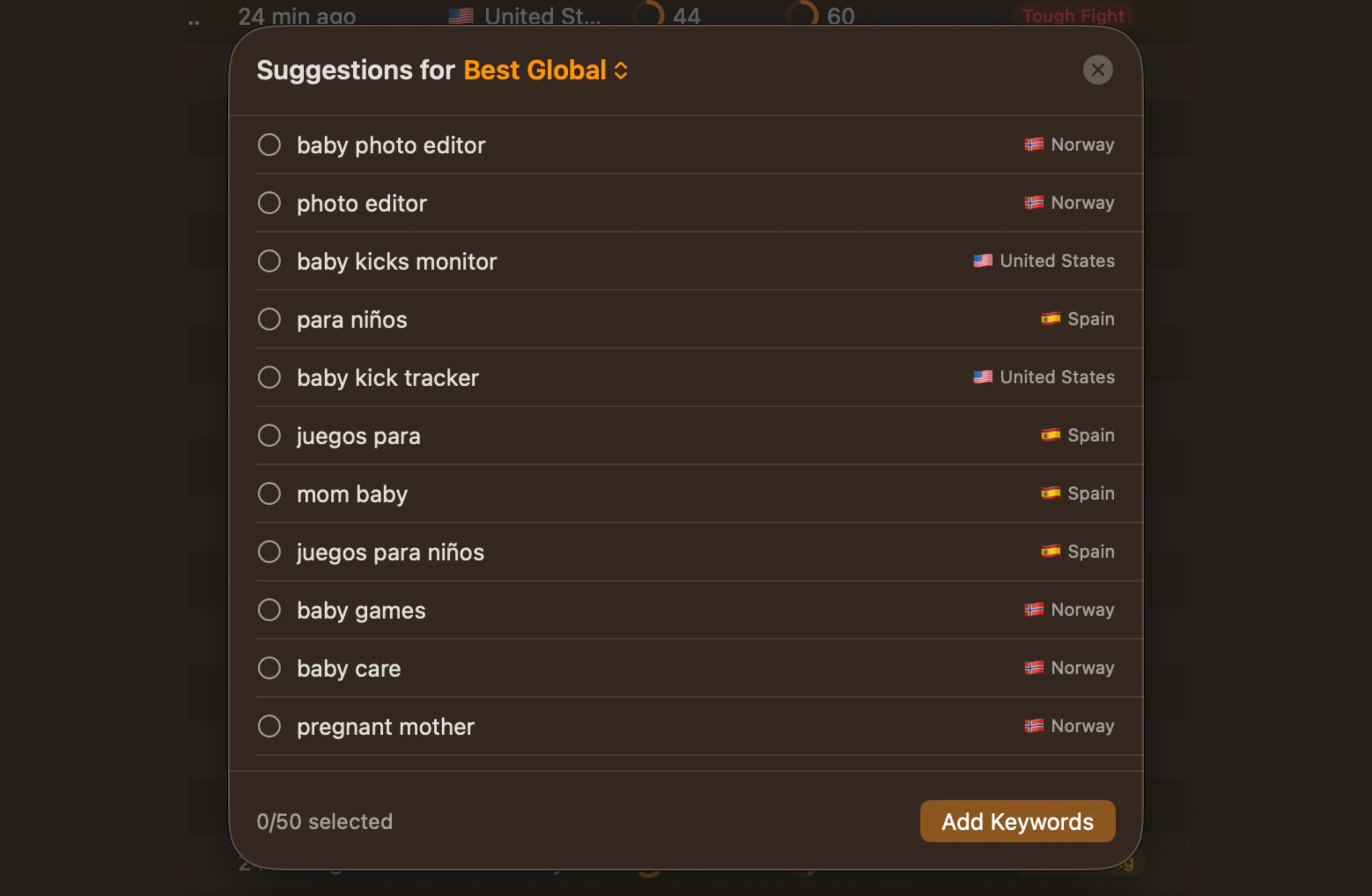
AI suggestions that surface keywords you'd miss through manual research, but every suggestion comes with verifiable data. Suggestions are pre-filtered to popularity ≥15, ranked by opportunity score, and show full targeting labels and download estimates. The AI finds candidates; you evaluate them with the same data you use for any keyword decision. It's AI-assisted, not AI-decided.
Metadata editor with App Store Connect integration. Edit your metadata alongside your keyword research data, with real-time character counts and targeting labels visible. You control every character, which matters when your entire organic strategy lives in 100 characters.
Pricing breakdown
| App Radar Basic | App Radar Pro | App Radar Enterprise | AppSprint ASO Trial | AppSprint ASO Solo | AppSprint ASO Pro | |
|---|---|---|---|---|---|---|
| Monthly price | ~$29/mo | ~$59/mo | ~$99/mo | €0 (3 days) | €19/mo (€76/yr) | €39/mo (€156/yr) |
| Keyword research | Yes | Yes | Yes | Full | Full | Full |
| Targeting labels | No | No | No | Yes | Yes | Yes |
| AI suggestions | Basic | Full | Full | Full (pop ≥15, opportunity scoring) | Full | Full |
| Download/MRR estimates | No | Basic | Yes | Yes | Yes | Yes |
| Metadata auto-optimization | No | Yes | Yes | N/A (manual) | N/A (manual) | N/A (manual) |
| Competitor analysis | Limited | Yes | Full | Full (66 countries) | Full | Full |
| Tracking keywords | Limited | More | Extensive | Full during trial | 50 | 500 |
| Google Play | Yes | Yes | Yes | No | No | No |
The pattern is consistent across ASO tools: the entry-level plan gets you in the door, but competitor analysis — the feature that actually drives strategy — requires a higher tier. AppSprint ASO includes competitor analysis, targeting labels, and download/MRR data at every tier, including the free trial. Yearly plans save 3 months.
AI-assisted vs AI-decided
This is the philosophical split between the two tools, and it's worth understanding before you choose.
App Radar's approach (AI-decided): The AI analyzes your app, your category, and your keywords, then tells you what to change. You can accept or reject suggestions, but the AI is the strategist. This works well if you don't have strong opinions about your keyword strategy or if you're managing too many apps to make manual decisions for each one.
AppSprint ASO's approach (AI-assisted): The AI surfaces keyword opportunities, but you make the strategic decisions. AI suggestions come with full data transparency — targeting labels, download estimates, MRR data, opportunity scores — so you can see exactly why a keyword might be worth targeting and decide for yourself. This works well when you understand your niche and want data to validate your instincts rather than replace them.
For most developers with one to three apps — whether solo, freelancing, or working on side projects — the AI-assisted approach produces better results because you know your users, your competitors, and your category in ways that a general-purpose algorithm doesn't. You know that targeting "sleep stories for adults" makes sense for your app even though the keyword volume is modest, because you've read the reviews and know that's what your best users love about it.
From the trenches
A developer was using App Radar's automated suggestions for a language learning app. The AI recommended targeting "learn english" and "language app" — high-volume terms that made statistical sense. But the developer's app was specifically a vocabulary builder for JLPT (Japanese Language Proficiency Test) preparation, a niche where generic language-learning keywords attract the wrong users entirely.
He switched to AppSprint ASO, ran competitor analysis on the top JLPT prep apps, and found keywords like "jlpt vocabulary," "kanji practice n3," and "japanese word quiz." These terms had lower volume than "learn english" (obviously) but dramatically higher relevance — and AppSprint ASO's targeting labels showed them as Hidden Gem and Sweet Spot keywords, confirming they were achievable targets.
Within a month, his conversion rate from impressions to installs doubled because the people finding his app were actually looking for what he built. Total downloads went up 35% despite targeting lower-volume keywords. The algorithm optimized for volume; the developer optimized for fit.
Who should use which tool
App Radar makes sense if:
- You want AI to drive your ASO optimization with minimal manual work
- You manage multiple apps and need automation at scale
- You need both App Store and Google Play optimization
- Your budget accommodates $59-99/month for full features
- You trust automated metadata suggestions over manual optimization
AppSprint ASO makes sense if:
- You prefer making your own keyword decisions with good data
- You want targeting labels, download estimates, and MRR data for every keyword
- You want the most accurate competitor keyword data available across 66 countries
- You're a solo developer, freelancer, or small team focused on the App Store
- Your budget favors €19-39/month with no feature gates
- You want to start with a full-featured free trial immediately
The bottom line
App Radar is a polished platform with genuine AI capabilities and dual-platform support. If you manage multiple apps and want automation to reduce your ASO workload, it delivers. But the pricing for full features ($59-99/month) puts it in the same bracket as tools with more comprehensive data, and the automation philosophy means trusting an algorithm with decisions that benefit from human context.
AppSprint ASO is cheaper, more focused, and puts you in control. For developers with one to three Apple App Store apps — whether you're building full-time, freelancing, or shipping side projects — the combination of accurate data, targeting labels, download and MRR estimates, 66-country coverage, and a manual-control workflow at €19-39/month typically outperforms automated suggestions. Because you know your app and your users better than any algorithm.
Try the AppSprint ASO free trial and look up the same competitors in both tools. If your niche is specialized at all, the accuracy difference in competitor data will be visible immediately. For more comparisons, see ASOdesk vs AppSprint ASO or the affordable ASO tools guide.
Frequently Asked Questions
- Is App Radar or AppSprint ASO better for solo developers?
- AppSprint ASO is purpose-built for solo developers, freelancers, and small teams with focused features and lower pricing (€19/mo Solo, €39/mo Pro). App Radar targets a broader audience including agencies and offers more features, but at a higher price point.
- How much does App Radar cost?
- App Radar's paid plans start around $29/month for a basic plan with limited features. Plans with full keyword tracking and competitor analysis run $59-99/month.
- Does App Radar have AI features?
- Yes, App Radar uses AI for keyword suggestions and metadata optimization recommendations. AppSprint ASO also offers AI-powered keyword suggestions with real App Store data backing each recommendation, plus targeting labels and download estimates.
- Can App Radar optimize for both App Store and Google Play?
- Yes, App Radar covers both platforms. AppSprint ASO currently focuses on the Apple App Store across 66 countries.
Research, optimize, grow
Don't waste time guessing keywords or overpaying for enterprise tools you'll never fully use.


Trusted by 200+ developers