Astro vs AppSprint ASO: ASO Tool Comparison
Comparing Astro and AppSprint ASO for App Store Optimization. Data accuracy, features, pricing, and which tool gives you keywords you can actually trust.
March 23, 2026
When you're choosing an ASO tool, the features list is only half the story. Both Astro and AppSprint ASO offer keyword research, competitor analysis, and rank tracking. On paper they look comparable. But the real question is whether the data these tools show you is accurate enough to make decisions with. We've tested both tools extensively, and the difference in data quality — especially for competitor analysis — is the reason this comparison exists.
Quick comparison
| Feature | Astro | AppSprint ASO |
|---|---|---|
| Keyword research | Yes, popularity and competition scores | Yes, popularity, difficulty, targeting labels, download estimates |
| Competitor analysis | Yes, but uses modeled/estimated data | Yes, uses actual App Store ranking data |
| Keyword tracking | Yes, daily rank tracking | Yes, daily tracking with trend charts |
| Keyword suggestions | Yes | Yes, including AI-powered suggestions with opportunity scoring |
| Targeting labels | No | Yes — Sweet Spot, Hidden Gem, Quick Win, High Potential, Competitive, Very Competitive |
| Multi-country | Limited | 66 countries with world ranking map |
| Pricing (entry) | Free tier available, paid from ~$49/mo | €19/mo Solo, €39/mo Pro (yearly saves 3 months) |
| Data source | Modeled estimates and statistical inference | Direct App Store ranking data |
| Built for indie devs | Partially — has some enterprise features | Yes, designed for solo developers, freelancers, and small teams |
| Apple Search Ads | Basic integration | Campaign management with cannibalization detection |
What Astro does well
Astro has built a polished product with a clean interface. The onboarding is smooth, and you can get started quickly with basic keyword research. Their free tier is genuinely useful for developers who want to explore ASO without committing to a paid tool right away.
The keyword research tool shows popularity and competition data that's generally reasonable for common, high-volume terms. If you're searching for broad keywords like "fitness app" or "photo editor," Astro's data gives you a rough sense of the landscape. Their keyword suggestion feature surfaces related terms, and the daily rank tracking works reliably.
Astro also includes some features beyond pure ASO, like basic review monitoring and category ranking tracking. If you want a single tool that gives you a surface-level view of multiple metrics, Astro covers the basics.
Where Astro falls short: the data accuracy problem
This is the core issue, and it's not a minor one. Astro uses modeled data for significant parts of its keyword intelligence, particularly competitor keyword analysis. Instead of pulling actual ranking data from the App Store, it uses statistical models to estimate which keywords an app might rank for.
For basic keyword research — looking up the popularity of a term you already have in mind — this approach works reasonably well. The problems start when you rely on Astro for competitor analysis, which is where ASO decisions get made.
The "I am" affirmation app test
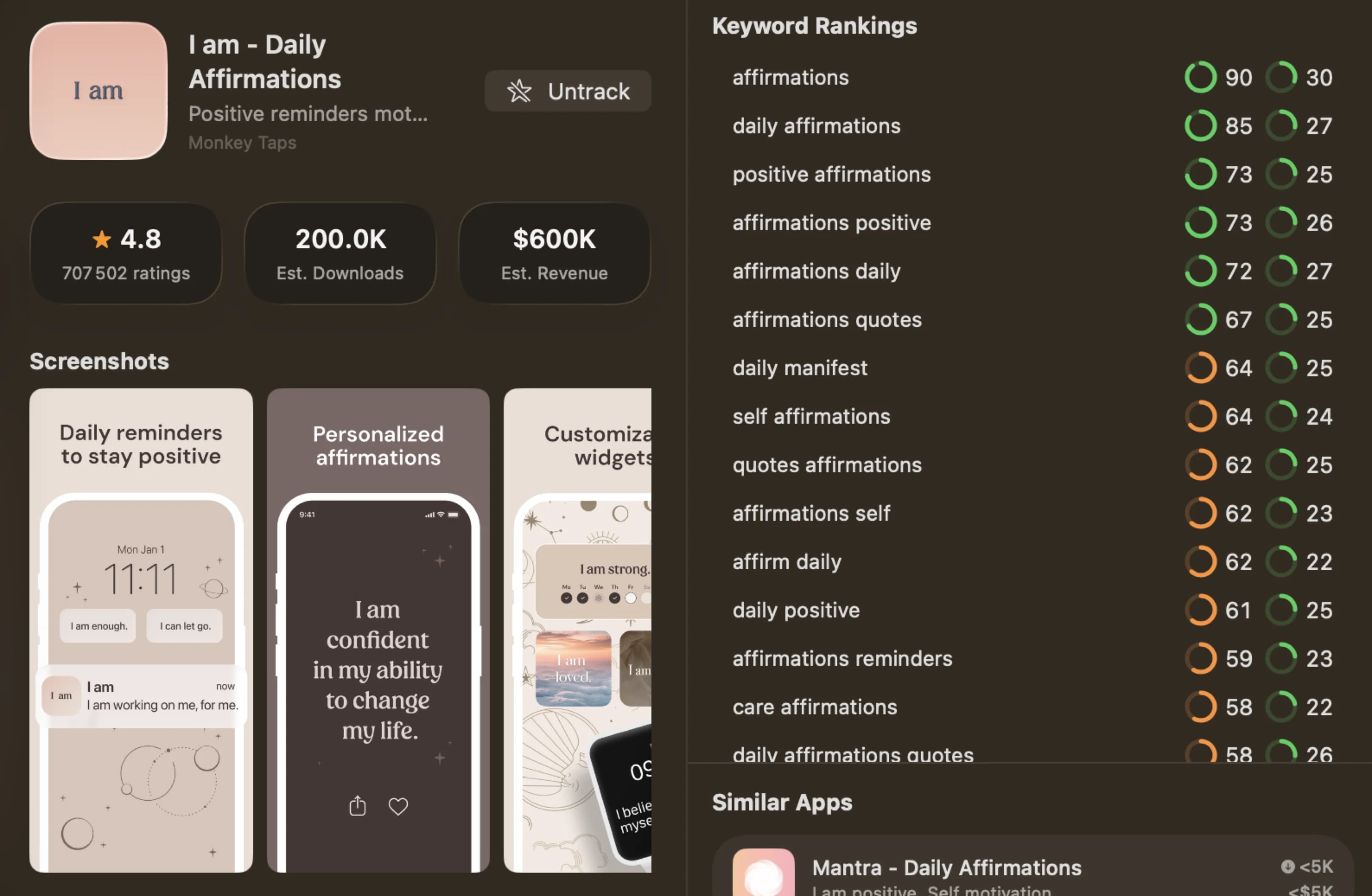
Here's a real example that illustrates the problem. We looked up a popular "I am" affirmation app in Astro to see which keywords it ranks for. Competitor keyword data is supposed to tell you what terms are driving an app's organic visibility, so you can find gaps and opportunities.
Astro returned keywords like "free app," "instagram," and "facebook" as terms this affirmation app ranks for.
Think about that for a second. An affirmation app ranking for "instagram"? Nobody finds a daily affirmations app by searching "instagram" in the App Store. These are high-volume generic terms that Astro's model associated with the app, probably because the app has significant downloads and those terms have high search volume. The statistical model finds a correlation that doesn't represent reality.
We ran the same test in AppSprint ASO. The results were completely different: "daily affirmations," "positive mindset," "self love app," "morning affirmation," and "i am affirmations." These are the keywords that the app actually ranks for in the App Store — terms that users genuinely search when looking for an affirmation app.
Why this matters for your ASO decisions
If you're using Astro's competitor data to find keyword opportunities, you're building your strategy on a faulty foundation. Specifically:
- You target irrelevant keywords. If Astro tells you a competitor ranks for "free app," you might waste keyword characters targeting that term, which won't help your affirmation app get discovered.
- You miss real opportunities. While Astro shows you noise, it may miss the actual long-tail keywords your competitor ranks for — the terms where you could realistically compete.
- You can't identify genuine gaps. Competitor analysis is about finding terms competitors rank for that you don't target. If the competitor keyword list is wrong, your gap analysis is wrong, and your entire keyword strategy is built on bad data.
If you can't trust the data, you can't make decisions. And if you're paying for a tool that gives you data you can't trust, you're paying for a false sense of certainty.
What AppSprint ASO does differently
AppSprint ASO pulls actual ranking data from the App Store. When you look up a competitor, you see the keywords they genuinely rank for, with real position numbers. There's no statistical modeling filling in gaps with plausible-but-wrong data.
This is a deliberate technical choice, not a limitation. Modeled data scales more easily because you can generate keyword associations without checking every app individually. But that scaling advantage comes at the cost of accuracy, and for developers making decisions about 100 characters of keywords, accuracy matters more than scale.
Keyword research in AppSprint ASO shows popularity and difficulty scores based on real App Store data. Every keyword gets a targeting label — Sweet Spot, Hidden Gem, Quick Win, High Potential, Competitive, or Very Competitive — so you can prioritize at a glance. You also see estimated daily downloads by position tier and top-10 MRR, so you know the potential value of ranking for a term.
Competitor analysis shows the keywords an app actually ranks for. Full stop. If an app doesn't rank for a term, it doesn't appear in the results. This means the list might be shorter than what Astro shows, but every keyword on it is real and actionable. You can check competitor data across 66 countries with an interactive world ranking map.
AI suggestions surface additional keywords based on your category and competitors, but every suggestion includes verifiable popularity and difficulty data. The AI finds candidates; the data helps you evaluate them.
Pricing breakdown
| Astro Free | Astro Paid | AppSprint ASO Trial | AppSprint ASO Solo | AppSprint ASO Pro | |
|---|---|---|---|---|---|
| Monthly price | $0 | ~$49/mo | €0 (3 days) | €19/mo (€76/yr) | €39/mo (€156/yr) |
| Keyword research | Basic (limited searches) | Full | Full access | Full | Full |
| Competitor analysis | Limited | Yes (modeled data) | Full (actual data) | Full (actual data) | Full (actual data) |
| Keyword tracking | Limited keywords | More keywords | Full | 50 keywords | 500 keywords |
| Targeting labels | No | No | Yes | Yes | Yes |
| Multi-country | Limited | Yes | 66 countries | 66 countries | 66 countries |
| Data accuracy | Modeled estimates | Modeled estimates | Actual App Store data | Actual App Store data | Actual App Store data |
Astro's free tier is useful for basic exploration, but the data accuracy issues persist across all tiers — the modeling approach is the same whether you're paying or not. AppSprint ASO's free trial gives you full access to features built on actual data, so you can validate the accuracy yourself before committing. Yearly plans save you 3 months — €76/year for Solo, €156/year for Pro.
Who should use which tool
Astro might work for you if:
- You only need basic keyword research for terms you already know
- You want a free tool for casual ASO exploration
- You don't rely heavily on competitor analysis data
- Surface-level metrics are enough for your workflow
AppSprint ASO is the better choice if:
- Competitor analysis is a key part of your ASO strategy
- You make keyword decisions based on competitive data
- You've noticed inconsistencies in other tools' competitor keywords
- You want to trust the data without second-guessing it
- You're a solo developer, freelancer, or small team who needs focused ASO tools without enterprise complexity
- You want to see keyword opportunities across multiple countries
The bottom line
Both Astro and AppSprint ASO cover the basic ASO toolkit: keyword research, tracking, and competitor analysis. The difference is under the hood. Astro's modeled data works fine for basic keyword lookups but falls apart when you need accurate competitor intelligence. AppSprint ASO's actual App Store data is reliable across the board, and that reliability is what makes competitor analysis genuinely useful instead of misleading.
If you've been using Astro and your competitor keyword data has ever looked suspiciously wrong — big generic terms showing up for niche apps, keywords that don't match the app's actual category — you're seeing the limitations of modeled data. Start an AppSprint ASO free trial, look up the same competitor, and compare the results. The difference will be obvious.
For a broader look at how AppSprint ASO compares to other tools in the market, check our AppTweak comparison or the affordable ASO tools guide.
Frequently Asked Questions
- Is AppSprint ASO more accurate than Astro for keyword data?
- AppSprint ASO pulls actual ranking data from the App Store, while Astro uses modeled estimates that can return irrelevant keywords. For competitor analysis especially, the accuracy difference is significant.
- How much does Astro cost compared to AppSprint ASO?
- Astro offers a free tier with limited features and paid plans starting around $49/month. AppSprint ASO starts at €19/month (Solo) or €39/month (Pro), with yearly plans that save you 3 months.
- Can Astro do everything AppSprint ASO does?
- Both tools cover keyword research, tracking, and competitor analysis. The key difference is data quality — Astro's modeled data can produce misleading results, particularly for competitor keyword analysis.
- Should I switch from Astro to AppSprint ASO?
- If you've noticed that Astro's competitor keywords don't match reality, or you're paying for features you don't use, AppSprint ASO is worth testing. The free trial lets you compare the data side-by-side.
Research, optimize, grow
Don't waste time guessing keywords or overpaying for enterprise tools you'll never fully use.


Trusted by 200+ developers